Screen mass spec data and draft reports in minutes. Automate your workflow.
SimplyMZ MCP uses deterministic analysis of the mzML files and an AI assistant to screen that data against your target compounds, thresholds and flags, then draft the report. Every number comes from fixed script. The analyst verifies and approves. Simply, precise and easy.
- Deterministic, traceable results
- Open-source core (GPLv3)
- Proudly Canadian
What is SimplyMZ MCP?
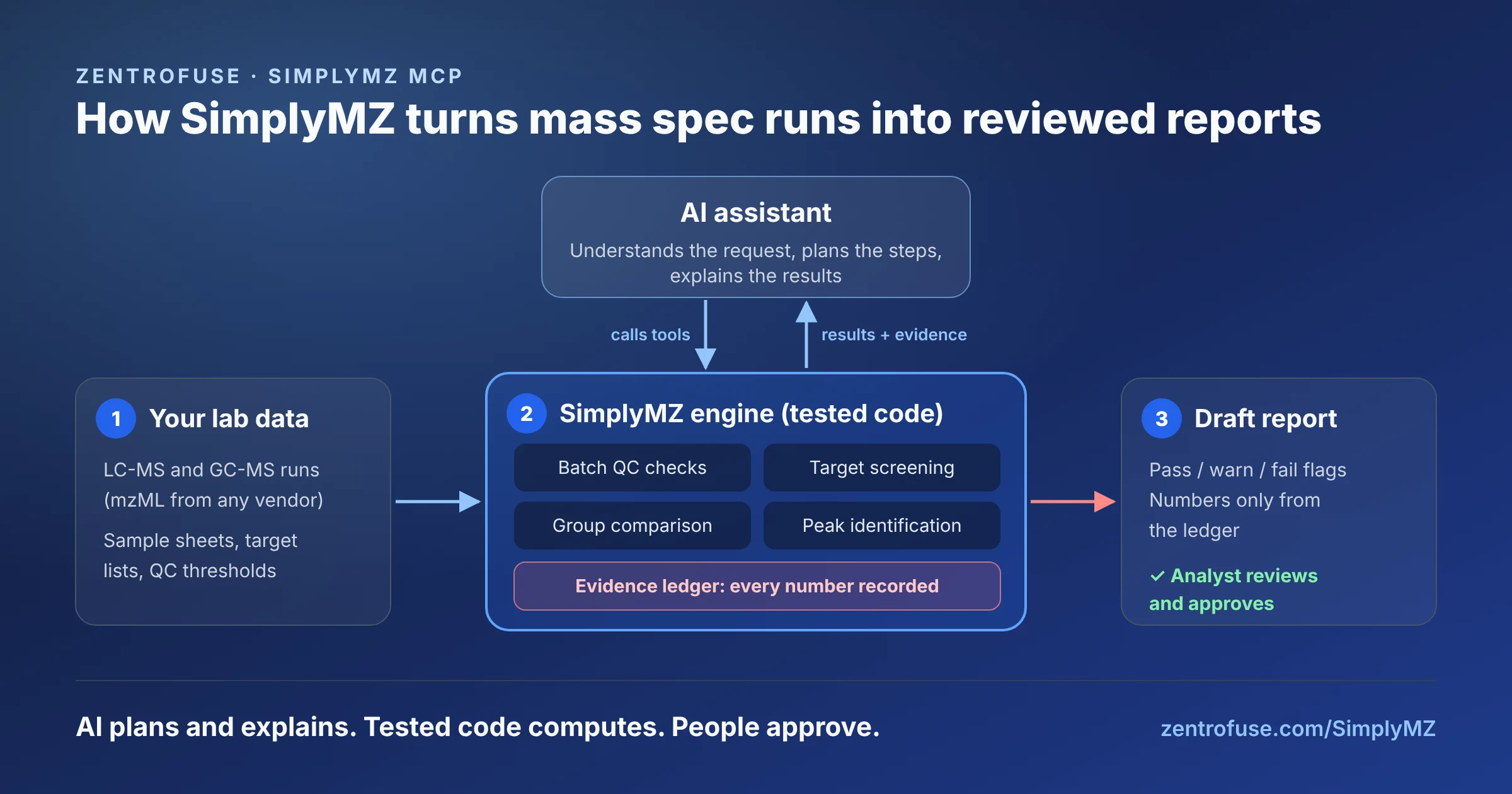
SimplyMZ MCP is a Model Context Protocol (MCP) server that connects an AI assistant, such as Claude, to your mass spectrometry data. The assistant understands a request in plain language ("did last night's batch pass?"), picks the right analysis tools and explains the result. The tools themselves are deterministic, tested code: they compute every QC metric, statistic and match, and an append-only evidence ledger records each number.
Reports can only contain numbers from that ledger, so the same data gives the same answer every time and every value can be traced back to the run it came from. Zentrofuse builds on the open-source core to deliver a version tuned to your compounds, rules, data formats and report template.
Where lab hours go today
Routine mass spec work rarely stops at the instrument. SimplyMZ takes on the repetitive review and reporting that follows.
Hours of manual screening
Large result sets checked by hand against target compounds, thresholds and flags, batch after batch.
Copying results into reports
Values moved from instrument software into spreadsheets and report templates, with every copy a chance for error.
Inconsistent screening between analysts
Two people, two interpretations. The same rules should give the same answer, whoever runs the review.
Custom analysis without scripting
Scientists who need a custom check or comparison can ask for it in plain language instead of writing code.
AI for the conversation, tested code for the numbers
Your lab data goes in
LC-MS and GC-MS runs in mzML (convertible from any vendor format), plus your sample sheets, target lists and QC thresholds. SimplyMZ only reads the folder you point it at.
The engine computes, the AI explains
The AI assistant calls SimplyMZ tools for QC checks, screening, group comparison and peak identification. Each result is written to the evidence ledger with its source.
A draft report comes out
Pass, warn and fail flags with the offending samples named, in your report template. A number guard blocks any value that is not in the ledger. Your analyst reviews and approves.
AI plans and explains. Tested code computes. People approve.
Three workflows in the open-source core
19 tools and 4 ready-made prompts. Your custom version adds your own screening rules, target panels and report templates on top.
"Did last night's batch pass?"
Batch QC
Ten QC metrics, including retention-time drift, mass error, QC feature CV, carryover, blank contamination and scan dropouts, each marked pass, warn or fail against configurable thresholds.
"What's different between treated and control?"
Group comparison
Feature detection, blank filtering, log2 fold change, Welch t-test and Benjamini-Hochberg FDR, with small-sample caveats stated in the result.
"What is this peak?"
Peak identification
Formula candidates from accurate mass and isotope fit, spectral library matching, and a confidence level on the Schymanski scale from the evidence. It never claims a confirmed Level 1 identity.
Benchmarks from the public test suite
| Check | Result |
|---|---|
| QC fault detected at 2x its threshold (6 fault types) | 100% |
| QC false fail at half the threshold | 0% |
| True formula among candidates at 5 ppm (35 compounds) | 100% |
| Out-of-library spectra correctly given no identity | 100% |
| Decoy spectra false positives | 0% |
| Peak area accuracy at signal-to-noise of 100 or more | within 3% |
A SimplyMZ MCP tuned to your lab
The open-source core is a starting point. For each client we deliver a workflow-specific MCP that follows your rules and produces your reports, with deterministic results augmented by AI.
- Your compounds and panels: target lists, limits and repeat screening panels
- Your rules: thresholds, flags and the checks every report must follow
- Your data formats: instrument exports, mzML and result tables
- Your report template: client or regulator reports drafted the way you send them
- Your systems: LIMS, spreadsheets and email connections at the Enterprise tier
Who it is for
Labs running routine LC-MS, GC-MS or ICP-MS work with recurring screening and reporting:
- Water, environmental and other QA/QC labs, including ICP-MS metals labs
- Drinking water, municipal and provincial labs with regulatory reporting
- Contract testing labs: environmental, food and beverage, cannabis, pharma QC
- Clinical, toxicology and forensic labs
- Pharma and biotech analytical labs and CROs
- University and research core facilities
Best fit: high sample volume, repeat screening panels, reports that go to clients or regulators, and a small analyst team.
SimplyMZ MCP tiers
Delivered as a workflow-specific MCP and quoted by complexity. Prices are indicative, in Canadian dollars.
Starter
From $3,989 CAD
- One workflow
- One data pipeline, multiple instruments supported
- Up to 3 report templates
- Pilot on your real data
Extended
Quoted by complexity
- Several workflows
- Several data pipelines or formats
- Custom report templates
- Pilot on your real data
Enterprise
Quoted by complexity
- Multiple sites
- LIMS integration
- Other system integrations
- Phased roll-out
Indicative pricing. The final quote follows a review of your workflow.
From first call to roll-out
Review
We review your screening and reporting workflow: instruments, software, sample volume, rules and the time it takes today.
Tune
We tune SimplyMZ MCP to your compounds, rules, data formats and report template.
Pilot and roll out
We pilot on your real data, compare against your current results, then roll it out to your team.
How we keep results trustworthy
- AI assists and people approve results. Calculations are done by tested code, never by the language model.
- Every reported number is traceable to an evidence record and the run it came from.
- Method validation stays with your lab's quality system. We do not promise compliance, certification or timelines before discovery.
- The open-source release is for research use. Your custom implementation is validated by you on your own data.
A chemist who writes software
SimplyMZ is built by Yuri Falcao, founder of Zentrofuse. He holds an MSc in Chemistry, ran two analytical chemistry laboratories with GC-MS and LC-MS instruments, and worked at Sciex on test automation and release verification for mass spectrometry software, including an mzML file converter.
That mix of bench work and software engineering is why SimplyMZ treats numbers the way a careful analyst would: computed by code you can test, recorded with their evidence, and never invented by the AI.
Questions labs ask
What is SimplyMZ MCP?
SimplyMZ MCP is a Model Context Protocol server that connects an AI assistant such as Claude to mass spectrometry data. The AI plans the analysis and explains the results, while tested, deterministic code performs every calculation and an evidence ledger records each number used in a report.
Does the AI calculate the results?
No. The AI decides which tools to call and writes the explanation. QC metrics, statistics, formula fits and library matches are computed by tested code, and reports can only contain numbers recorded in the evidence ledger. An analyst reviews and approves every report.
Which instruments and data formats does SimplyMZ support?
The open-source release reads mzML, which vendor files from LC-MS and GC-MS instruments can be converted to with ProteoWizard msconvert. Custom implementations can be tuned to other exports and formats, including ICP-MS result tables, as part of the project scope.
How much does a SimplyMZ implementation cost?
Pricing is indicative and in Canadian dollars. Starter, covering one workflow, one data pipeline with multiple instruments supported and up to 3 report templates, starts from $3,989 CAD. Extended and Enterprise implementations are quoted by complexity. The final quote follows a review of your workflow.
Is SimplyMZ validated for regulatory or clinical use?
The open-source release is for research use. For a custom implementation, Zentrofuse provides tests and documentation, and method validation and regulatory sign-off stay with the client's own quality system. Zentrofuse does not promise compliance or certification before discovery.
Is SimplyMZ open source?
Yes. The core SimplyMZ MCP server is released under GPL-3.0-or-later on GitHub. Zentrofuse sells the workflow tuning, integration, pilot and roll-out for each lab.
Does your team spend hours on repetitive data review or reporting?
Tell us how you screen and report today. We will reply to book a short call and show you where SimplyMZ fits, using your workflow, not a generic demo.
- Which instruments and software produce your data, and how many samples a week?
- How do you screen results and build reports today, and how long does it take?
- What rules or checks does every report have to follow?
Prefer email? hello@zentrofuse.com
Try the open-source core
Run SimplyMZ locally with Claude Desktop or Claude Code on the included sample data. Code, docs, design decisions and benchmarks are all public.